Stockholm/2026 · 06 · 28/Initial Report

Merging Freedom Fibre & TrueSpeed into a single, scalable operator.

VX Fiber’s technical, IT systems and network due diligence — and a pragmatic three-phase migration plan that lands cross-network sales by September 2026 and a harmonised operating model by mid-2027.

Phase 1

Cross-network sales

End of Sept 2026

Phase 2

SDN, vendor-agnostic

EoY 2026

Phase 3

Harmonised OSS/BSS

Mid 2027

01 · Engagement

Background & objectives

Freedom Fibre engaged VX Fiber to assess and advise on the way forward of the merger between Freedom Fibre and TrueSpeed. The initial focus is technology and operational capabilities supporting the business plan in the short to long term — tactically to lift the take-rate via cross-network sales, and strategically to enable an M&A factory able to absorb further fiber networks within a few years.

The objective is not a detailed system audit, but to identify the most effective path toward a common operating model that lets both organisations operate as a single business while preserving operational continuity and minimising unnecessary short-term change. Out of scope: FWA, CRM, ERP, BI, GIS, FE and construction software and partners.

A key requirement: both retail brands must be able to sell and deliver across each other’s network — TrueSpeed services on Freedom Fibre’s network and LilaConnect services on TrueSpeed’s network.

5

Stakeholder interviews

OSS/BSS, network arch., delivery

2

Networks merged

Freedom Fibre + TrueSpeed

4

Access technologies

DZS, Nokia, P2P, FWA

02 · Status

Executive summary

TrueSpeed IT stack

Well-designed and devops-capable in-house, but architected vertically for one operator. Scaling it is a massive lift that does not make sense given the alternatives.

LilaConnect stack

A lean ISP operation built around the Gaiia CRM. Provisioning is delegated to wholesale partners (Cadence on its own footprint, TrueSpeed on cross-sell), so the stack stays focused on sales, customer experience and billing rather than network operations.

Freedom Fibre stack

Built around Agiloft as a heavily customised document/process engine alongside in-house tooling. It has served FFL well but does not scale for an M&A platform and is a candidate for replacement in H1 2027.

Gaiia

The group-standard ISP CRM, chosen for every brand across the FreedomFibre / TrueSpeed group. Owns customers, orders, comms and self-service, and integrates via APIs to Agiloft for wholesale, Cloudsight ACS for device management, and Stripe for recurring billing. It is a retail/BSS platform — it does not provision the network itself.

Inmanta

A vendor- and technology-agnostic network provisioning and orchestration platform — exactly the kind of engine NewCo needs to drive multi-vendor, multi-technology access networks. The gap is people, not product: there is currently no networking team with the depth and bandwidth to model, configure and operate it safely, so its potential is largely untapped and incident management remains exposed.

Agiloft

Freedom Fibre's wholesale platform and operational inventory — a heavily customised document and process engine that today carries partner onboarding, work-order flows, contract and asset records. Most of its capability lives in bespoke configurations and in-house scripts maintained by a small group of specialists, with point integrations to Gaiia, Inmanta and the network tooling around it.

Network operations capacity

The binding constraint of the merger. On both FFL and TrueSpeed, network functions are stretched and depend on a small group of specialists; today's flows are one-way routes built to survive the next period, not to scale. There is no spare bandwidth to absorb merger volumes, new vendors, additional access technologies or future M&A, and successive tweaks are compounding platform, process and people fragmentation. VX Fiber (or a similar partner) should take operational ownership of network design and the related OSS systems so the in-house teams can focus on delivering Phase 1 cross-sales and the Phase 2 / 3 platform transition.

The “so what”

Two approaches must advance simultaneously: do the needful now and build the M&A factory that supports the business plan — and neither works unless the network operations gap is closed first.

02b · The binding constraint

The network operations gap

Across both sides of the merger, the single biggest risk to the plan is not the CRM, the wholesale layer or the billing stack — it is the capacity, depth and scalability of the teams and tooling that actually run the networks.

Network functions are stressed
Both at FFL and Truespeed side the network functions are stressed, [have] built a one-way route that [does] not scale and will need capability to operate existing and future increasing complexity and scale.

VX Fiber report · Executive summary

Manual steps in critical paths
Several fulfilment and activation processes continue to depend on manual intervention — Nokia activation, Active Ethernet provisioning, manual order handling, serial number registration. Manual intervention within critical fulfilment paths will become increasingly challenging as volumes grow.

Finding 4 — Manual processes embedded

Reliance on specialist knowledge
A significant amount of operational capability depends on specialist knowledge held within relatively small engineering and operational teams — custom provisioning services, internal APIs, technology-specific activation workflows, bespoke integrations. Key-person risk, longer onboarding cycles, reduced operational resilience.

Finding 3 — Reliance on specialist knowledge

Inmanta exposure
Inmanta software requires the right steering; FFL/TS lack skills and bandwidth, and incident management becomes risky, hard and a major exposure.

VX Fiber report · Executive summary

Multiple sources of operational truth
Operational and inventory data are distributed across Agiloft, TrueDB, Inmanta, NetBox, DPCOM and vendor-specific platforms. There is no common orchestration layer providing a unified view of service fulfilment and inventory.

Finding 5 — Multiple sources of truth

Tweaks compound the problem
Network tweaks to survive the next period constantly increase system complexity, operational complexity, high skill requirements and process, platform and people fragmentation.

VX Fiber report · Executive summary

Why it matters

  • Cannot absorb merger volumes without slowing fulfilment
  • Every new vendor or access technology becomes a bespoke integration
  • Key-person risk on a handful of engineers (Simon, Phil and a small team)
  • Incident response is hard and exposed — especially around Inmanta
  • M&A integration timelines stretch with each acquisition

Recommendation

Engage VX Fiber (or similar) to take operational ownership of network design and the related OSS systems.

Free the in-house engineers to deliver Phase 1 cross-sales and the Phase 2 / 3 platform transition, while a dedicated network-ops partner absorbs growing complexity, vendor count and M&A throughput.

03 · Plan

The three-phase migration

A staged path from minimal-change cross-sales to a unified, technology-agnostic operating model — ready for the next merger.

  1. Jun '26

    Initial report, Phase 1 engagement & LOI

  2. Aug '26

    Final report, Phase 2 validated, IRL workshops

  3. Sep '26

    Phase 1 delivery · Phase 3 proposal

  4. Dec '26

    Phase 2 delivery

  5. Mid '27

    Phase 3 delivery — Agiloft retired

Phase 1

Cross-network sales — minimal change

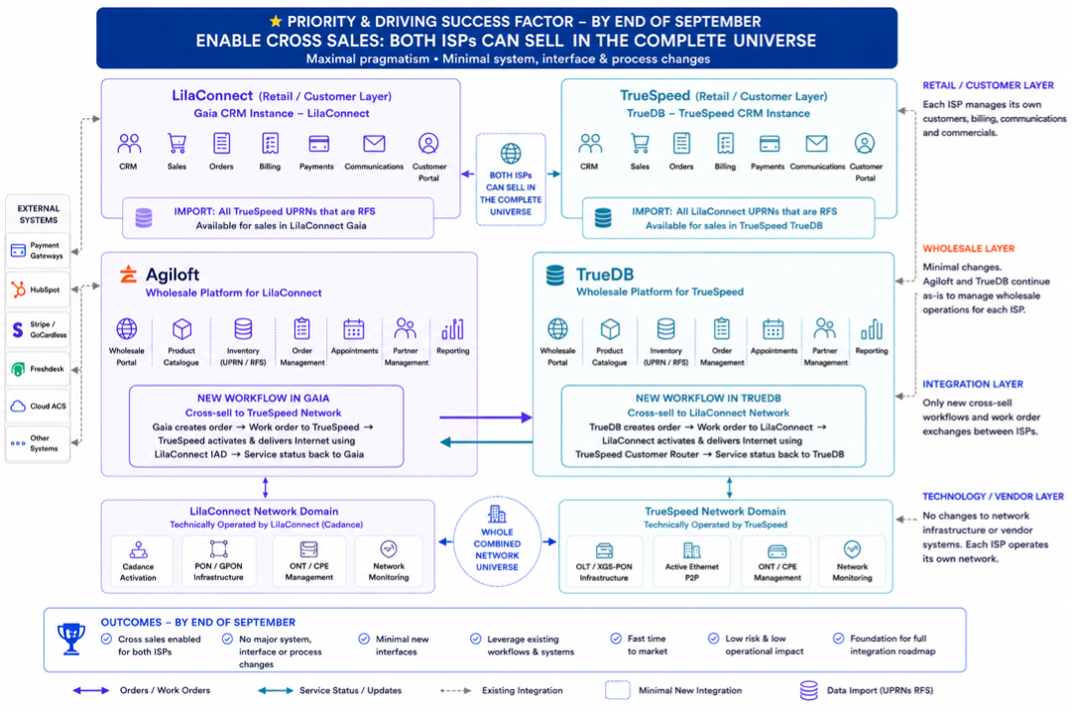
LilaConnect and TrueSpeed can order on any UPRN in the combined FFL/TS universe. Delivery and provisioning stay as-is.

Target

End of September 2026

Scope & Approach

  • Import all TrueSpeed RFS UPRNs into LilaConnect's Gaiia CRM instance.
  • Import all LilaConnect RFS UPRNs into TrueSpeed's TrueDB.
  • Gaiia workflow: sells on TrueSpeed network → work order to TrueSpeed → TrueSpeed delivers using a LilaConnect IAD. Billing stays with LilaConnect.
  • TrueDB workflow: sells on LilaConnect network → work order to LilaConnect → LilaConnect delivers (via Cadence) using a TrueSpeed router. Billing stays with TrueSpeed.
  • No major system, interface or process changes — leverage existing workflows.

Outcomes

  • Cross-sales enabled for both ISPs
  • Minimal new interfaces
  • Fast time to market
  • Low risk & low operational impact
  • Foundation for the full integration roadmap

Transition · Today (pre-merger baseline) Phase 1

Add cross-sales with the smallest possible footprint — no networks, billing, or stacks change hands.

New
  • · UPRN/RFS import flows between Gaiia ↔ TrueDB
  • · Cross-sell work-order workflow in both CRMs
  • · Cross-branded IAD/router on fulfilment
Unchanged
  • · LilaConnect Gaiia, TrueSpeed TrueDB
  • · Agiloft wholesale, Cadence activation
  • · Billing & customer ownership per ISP

Priority & driving success factor — by end of September

Enable cross-sales: both ISPs can sell in the complete universe

Maximal pragmatism • Minimal system, interface & process changes.

Click any tile for details →

Retail / Customer Layer

LilaConnect

Gaiia CRM Instance — LilaConnect

TrueSpeed

TrueDB — TrueSpeed CRM Instance

Wholesale Layer

Agiloft

Wholesale Platform for LilaConnect

TrueDB

Wholesale Platform for TrueSpeed

Integration Layer

New workflow in Gaiia

Cross-sell to TrueSpeed network

New workflow in TrueDB

Cross-sell to LilaConnect network

Technology / Vendor Layer

LilaConnect Network Domain

Technically operated by LilaConnect (Cadence)

TrueSpeed Network Domain

Technically operated by TrueSpeed

Outcomes

  • Cross-sales enabled for both ISPs
  • No major system, interface or process changes
  • Minimal new interfaces
  • Leverage existing workflows & systems
  • Fast time to market
  • Low risk & low operational impact
  • Foundation for full integration roadmap
View original VX Fiber diagram (PDF source)
Phase 1 architecture diagram — Cross-network sales — minimal change
Phase 2

Software-defined, technology-agnostic network

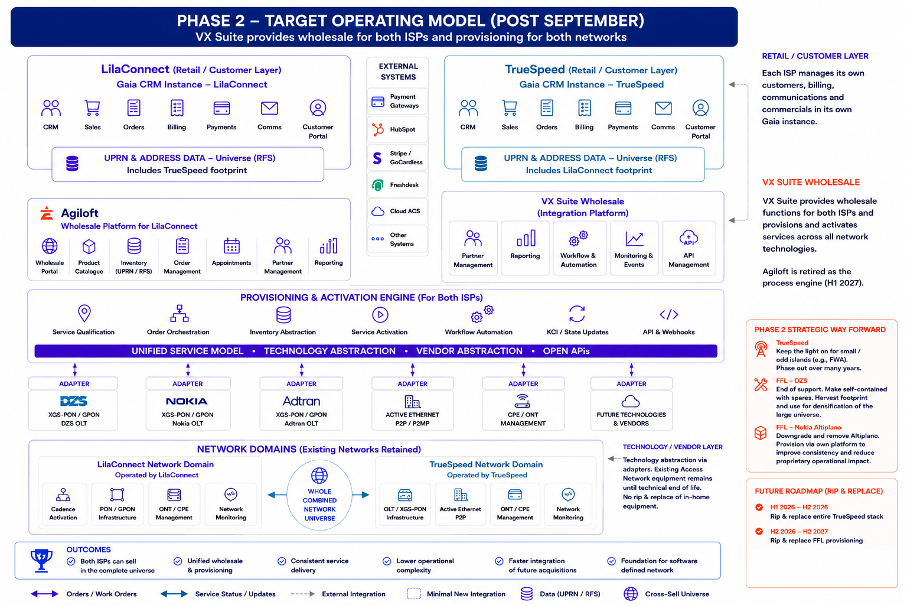
VX Suite becomes the unified wholesale and provisioning engine for both ISPs across all access technologies.

Target

End of 2026

Scope & Approach

  • Replacement of network equipment is avoided — especially in customer premises. Access kit remains until technical end-of-life.
  • TrueSpeed: small / odd islands (e.g. FWA) move to keep-the-lights-on and phase out over years.
  • FFL — DZS: end of support. Self-contain with spares, harvest equipment for densification.
  • FFL — Nokia: remove Altiplano, provision via own platform to end manual Bastion activation and restore monitoring.
  • Rip & replace the entire TrueSpeed provisioning stack; rip & replace FFL provisioning during H2 '26 – H2 '27.

Outcomes

  • Unified wholesale & provisioning
  • Consistent service delivery
  • Lower operational complexity
  • Faster integration of future acquisitions
  • Foundation for a software-defined network

Transition · Phase 1 Phase 2

VX Suite arrives as the unified wholesale & provisioning engine — TrueDB CRM and bespoke provisioning are phased out.

New
  • · VX Suite Wholesale (alongside Agiloft)
  • · Unified provisioning & activation with vendor adapters (DZS, Nokia, Adtran, AE)
  • · TrueSpeed migrated onto its own Gaiia instance
Changed
  • · FFL Nokia: Altiplano removed, provisioning via VX Suite — no more manual Bastion activation
  • · FFL DZS: self-contained with spares, harvested for densification
Retired / wound down
  • · TrueDB CRM
  • · TrueSpeed bespoke provisioning stack (rip & replace)
  • · TrueSpeed FWA islands → keep-the-lights-on
Unchanged
  • · Access kit in customer premises — no swap-outs
  • · Agiloft kept in parallel for the FFL footprint

Phase 2 — target operating model (post September)

VX Suite provides wholesale for both ISPs and provisioning for both networks

VX Suite is added alongside Agiloft. Existing networks are retained and abstracted via adapters.

Click any tile for details →

Retail / Customer Layer

LilaConnect

Gaiia CRM Instance — LilaConnect

TrueSpeed

Gaiia CRM Instance — TrueSpeed

VX Suite Wholesale (Integration Platform)

Agiloft

Wholesale Platform for LilaConnect (kept in parallel)

VX Suite Wholesale

Integration Platform — extensions added in Phase 2

Provisioning & Activation Engine (for both ISPs)

Provisioning & Activation Engine

Single engine for both networks

Network Domains (existing networks retained)

LilaConnect Network Domain

Operated by LilaConnect

TrueSpeed Network Domain

Operated by TrueSpeed

Strategic way forward

TrueSpeed — keep the lights on

Small / odd islands (e.g. FWA) move to keep-the-lights-on mode and phase out over the coming years.

FFL — DZS: end of support

Self-contain with spares, harvest equipment and use it for densification of the larger universe.

FFL — Nokia Altiplano

Downgrade and remove Altiplano. Provision via own platform to improve consistency and reduce proprietary operational impact.

Outcomes

  • Both ISPs can sell in the complete universe
  • Unified wholesale & provisioning
  • Consistent service delivery
  • Lower operational complexity
  • Faster integration of future acquisitions
  • Foundation for software-defined network
View original VX Fiber diagram (PDF source)
Phase 2 architecture diagram — Target operating model — VX Suite wholesale & provisioning
Phase 3

Harmonised OSS/BSS across the universe

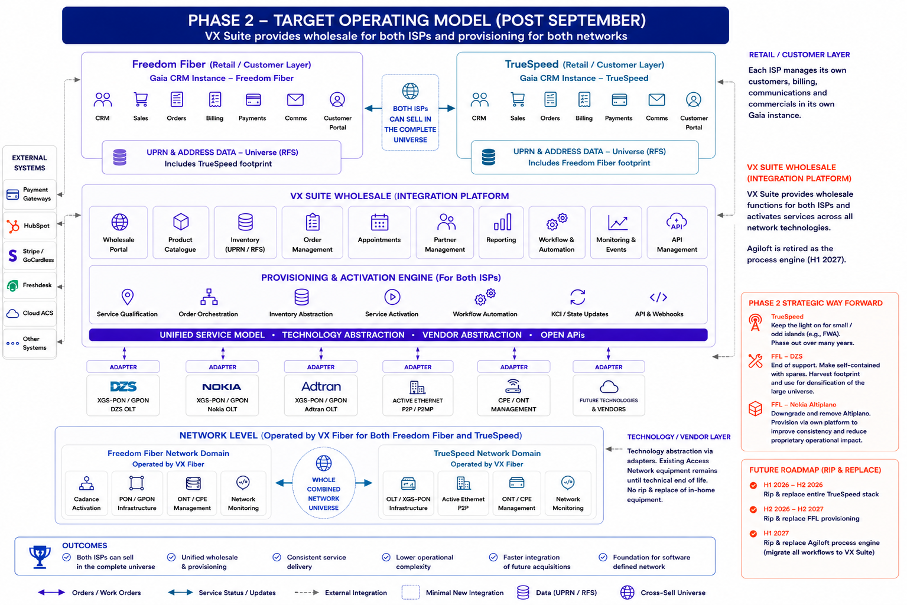
Both networks operated by VX Fiber on VX Suite. Agiloft retired as the process engine. One consistent operating model across the group.

Target

Mid 2027

Scope & Approach

  • Rip & replace the Agiloft process engine in H1 2027 — migrate all workflows to VX Suite.
  • VX Suite operates wholesale for both ISPs and provisions and activates services across every access technology via vendor adapters.
  • Both retail brands run on their own Gaiia instance for CRM, billing, comms and customer portal.
  • Unified service model, technology & vendor abstraction, open APIs — ready for the next merger.

Outcomes

  • Both ISPs selling in the complete universe
  • Harmonised workflows across the group
  • Repeatable M&A integration framework
  • Single operational truth for inventory & service

Transition · Phase 2 Phase 3

One operating model: VX Suite runs wholesale + provisioning for both networks. Agiloft retired. Ready for the next acquisition.

Retired
  • · Agiloft process engine (H1 2027)
  • · Cadence activation on the LilaConnect footprint
  • · Parallel wholesale platforms
Changed
  • · VX Suite becomes the single engine for wholesale & provisioning
  • · Network operated by VX Fiber across both footprints
Unchanged
  • · Independent Gaiia instance per retail brand
  • · Billing & customer ownership per ISP

Phase 3 — harmonised OSS/BSS across the universe

Both networks operated by VX Fiber on VX Suite. Agiloft retired.

One consistent operating model across the group — ready for the next merger.

Click any tile for details →

Retail / Customer Layer

Freedom Fiber

Gaiia CRM Instance — Freedom Fiber

TrueSpeed

Gaiia CRM Instance — TrueSpeed

VX Suite Wholesale (Integration Platform)

VX Suite Wholesale

Single wholesale platform for the group

Provisioning & Activation Engine (for both ISPs)

Provisioning & Activation Engine

Single engine for both networks

Network Level — operated by VX Fiber for both Freedom Fiber and TrueSpeed

Freedom Fiber Network Domain

Operated by VX Fiber

TrueSpeed Network Domain

Operated by VX Fiber

Strategic way forward

H1 2026 – H2 2026 · Rip & replace TrueSpeed stack

Replace the entire TrueSpeed provisioning stack with VX Suite for TrueSpeed's network.

H2 2026 – H2 2027 · Rip & replace FFL provisioning

Replace Freedom Fiber's provisioning stack with VX Suite, in two waves across the access vendors.

H1 2027 · Rip & replace Agiloft process engine

Migrate all Agiloft workflows to VX Suite Workflow & Automation. Agiloft retires.

Outcomes

  • Both ISPs sell in the complete universe
  • Unified wholesale & provisioning
  • Consistent service delivery
  • Lower operational complexity
  • Faster integration of future acquisitions
  • Foundation for software-defined network
View original VX Fiber diagram (PDF source)
Phase 3 architecture diagram — Harmonised OSS/BSS — both networks operated by VX Fiber on VX Suite

04 · Findings

Key findings

Absence of a common fulfilment layer

01

Fulfilment runs through technology- and vendor-specific workflows (DZS via Inmanta, Nokia manual, Active Ethernet bespoke, TrueSpeed custom). Scales through expertise, not standardisation.

Customer platforms contain network-specific logic

02

Customer-facing systems still need awareness of GPON, XGS-PON, Nokia, DZS, Active Ethernet. Couples retail to network choices.

Reliance on specialist knowledge

03

Critical capability lives in a small number of heads — custom services, internal APIs, bespoke integrations. Key-person risk.

Manual processes embedded in critical workflows

04

Nokia activation, Active Ethernet provisioning, serial-number registration. Cost and error exposure rise with volume.

Multiple sources of operational truth

05

Inventory and operations split across Agiloft, TrueDB, Inmanta, NetBox, DPCom and vendor platforms. No unified view.

Limited scalability for future M&A

06

Today's architecture worked for past growth but each new network needs bespoke integration. Costs rise per acquisition.

05 · Gap analysis

Current state → desired state

CapabilityCurrentDesired
Product CatalogueMultiple implementationsCommon service catalogue
Service QualificationMultiple systemsSingle qualification interface
ProvisioningTechnology-specificTechnology-agnostic
ActivationVendor-specificVendor abstraction
InventoryMultiple sourcesUnified service inventory
Open AccessPartially standardisedFully standardised
M&A ReadinessModerateHigh
AutomationPartialEnd-to-end orchestration

06 · Target architecture

One principle, three layers

Customer systems manage customers. Network systems manage infrastructure. VX Suite manages service orchestration in between.

Layer

Customer layer

Gaiia · Agiloft · TrueSpeed customer systems

Retain customer-facing platforms. They stop caring about underlying access technology.

Layer

VX Suite — orchestration

Qualification · product mapping · vendor & tech abstraction · status

Common fulfilment gateway and service-routing layer for the whole group.

Layer

Network layer

Nokia · DZS · Adtran · Active Ethernet · future vendors

Adapters per platform — change once in VX Suite, not across every customer system.

Accelerated Open Access

Onboard wholesale partners and ISPs through well-known interfaces — no technology-specific processes.

Technology independence

Customer systems become independent of vendor, access tech and activation platform choices.

Lower integration costs

Acquisitions integrate through VX Suite, not via multiple OSS/BSS integration projects.

Faster product introduction

New products land via service definitions and orchestration rules — not bespoke dev.

Reduced operational complexity

Ops teams work with one fulfilment model regardless of network or vendor.

Improved M&A readiness

A repeatable integration framework for every future acquisition.

07 · Per-segment plan

Network segments — action required

FFL — DZS (GPON / XGS-PON)

Abstracted via Inmanta today. VX Suite extends automated provisioning to all FFL technologies, superseding the Inmanta-only model.

FFL — Nokia (GPON / XGS-PON)

Remove Altiplano (blocks direct OLT access and SolarWinds monitoring). Highest immediate priority — restores monitoring and ends manual Bastion activation.

FFL — VX P2P

Upgrade VX tools to v2. FFL holds the contractual right to this upgrade. VX Suite exposes the API to bring P2P activation in-house.

TrueSpeed — West (XGS-PON)

Phase 2: replace OLT Manager / TrueDB provisioning stack with VX Suite. Move from batch SaltStack to event-driven real-time activation.

TrueSpeed — East (Active Ethernet)

Implement a QinQ wholesale model on the Extreme VSP fabric (S-VLAN per SP, C-VLAN per customer). Unlocks wholesale for most TrueSpeed customers.

TrueSpeed — Wireless / FWA

VX Suite covers wireless provisioning. Include in unified platform and wholesale API.

County GPON

ARIS retired as County customers migrate. County Altice OLTs brought under VX Suite or retired with migration.

08 · People

Organisation & staff assessment

Credible, experienced teams on both sides — but the combined organisation is not yet structured as a scalable M&A integration platform.

Victoria Jones

Head of IT Systems — FFL

Operational and OSS/BSS leader. Led LilaConnect migration to Gaiia and clarified Gaiia / Agiloft roles in the target architecture. Pragmatic, cost-aware, focused on a repeatable platform for future M&A.

Simon Mellor

Head of Networks Architecture — FFL

Key technical and architectural leader for the wholesale platform. Owns the end-to-end logic across Agiloft, Kong, APIs, AWS orchestration and Inmanta activation. Architectural knowledge to be documented and shared.

Phil Steed

Software Architect — FFL

Generalist · fixer · can script.

Nelson Missier

Sales manager — NewCo

Modest, critical view of current FFL/TS software and Open Access business model.

Phil Stiby

TrueSpeed

Knowledgeable — built what the business needed at the time.

Strengths

  • · FFL: wholesale, Open Access and API-led platform capability
  • · TrueSpeed: vertically integrated retail ops, complex network experience
  • · Directionally sound target architecture

Gaps

  • · Heavy dependence on a small number of individuals
  • · Fragmented systems, no single source of truth for inventory
  • · No formalised, repeatable merger playbook yet

Data quality

Gaiia

Good quality data based on export from VX CRM.

TrueDB

Unable to get a clear picture of structure or data quality.

DPCom

FFL: as-builds of the VX/Lila network verified. Rest of FFL and TS coverage unclear.

09 · Way forward

The way forward

Short-term delivery and the long-term M&A platform advance simultaneously.

  1. 1

    June 2026

    Initial report

    Phase 1 engagement proposal and LOI for the way forward.

  2. 2

    August 2026

    Final report

    Validated Phase 2 assessment, IRL meetings with TrueSpeed and FFL. Agreed documentation shared by FFL by end of June.

  3. 3

    September 2026

    Phase 1 delivery

    Cross-network sales live · Phase 3 proposal issued.

  4. 4

    December 2026

    Phase 2 delivery

    Software-defined, technology-agnostic provisioning operational.

  5. 5

    Mid 2027

    Phase 3 delivery

    Agiloft retired, harmonised OSS/BSS across the universe.

Recommendation

Adopt VX Suite as the strategic orchestration platform for the combined organisation.

Balancing short-term delivery with long-term strategy: hit the October 2026 cross-sales objective while establishing a scalable operating model ready for Open Access growth, network consolidation, technology evolution and the next merger.